
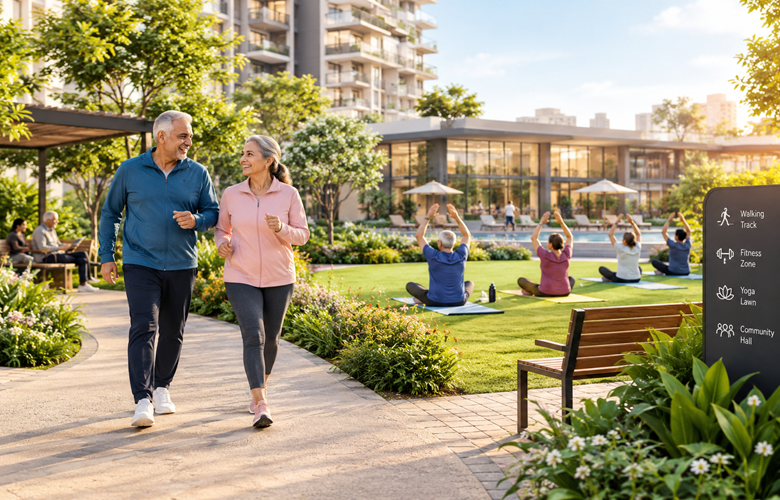
A well-planned Active ageing community in Sector 63 Gurgaon supports residents over 60 by making daily movement, social connections, and medical support easily accessible beyond their apartment doors. Global age-friendly planning evaluates eight key domains: outdoor spaces, transport, housing, social participation, respect and inclusion, civic participation and work, communication, and health and community support. Shared spaces should encourage 150–300 minutes of moderate physical activity per week, while regular social activities can help address loneliness, a concern reported by 68% of Indian elders. Convenient access to doctors and wellness facilities further strengthens everyday security, independence, and quality of life. Ultimately, an age-friendly community is defined not just by the home itself, but by the environment and support system surrounding it.
Active Ageing Meaning in Simple Terms
Active ageing community in Sector 63 Gurgaon, means optimising opportunities for health, participation and security so that quality of life improves as people grow older. Only 1 of those 3 parts is about exercise.
For a homebuyer, the definition becomes 3 practical questions about any residential project. Does the layout invite daily movement? Do neighbours, clubs and events give residents a reason to step out? Does help arrive quickly when something goes wrong?
Grab bars and wide doors inside a flat answer only part of the third question. The shared grounds, services and social life answer the rest, which is why the indoor checklist in our guide to senior-friendly home features is only the first step.
Active Ageing Index: 4 Domains Families Can Borrow
The Active Ageing Index measures how well older people use their potential through 22 indicators grouped into 4 domains: employment; participation in society; independent, healthy and secure living; and capacity and enabling environment.
A housing project cannot control employment, but it shapes the other 3 domains every day:
- Participation in society: clubs, volunteering roles and events that residents help run.
- Independent, healthy and secure living: walkable grounds, fitness spaces, medical help on site and emergency response.
- Enabling environment: dependable transport, in-person help with technology and services that let residents manage their own day.
Financial safety matters too. Only about 30 percent of India’s elderly population is financially independent, so any assessment of a later-life home should include predictable maintenance and service charges alongside amenities.
Age-Friendly Community Checklist With Measurable Tests
City planners developed the age-friendly checklist with older residents in 33 cities across 22 countries. Each of its 8 domains converts into a test you can run during a single tour:
- Outdoor spaces: a continuous, shaded walking loop with seating at regular points and no steps.
- Transport: a covered drop-off at the lobby and an arranged cab or shuttle for hospital and market trips.
- Housing: step-free movement from car to apartment and lifts large enough for a stretcher.
- Social participation: a printed monthly event calendar, not just a furnished clubhouse.
- Respect and inclusion: shared lawns or family areas where grandchildren are welcome.
- Civic participation and work: rooms residents can book for hobby clubs, teaching, volunteering or consulting.
- Communication: staff who help in person alongside any resident app.
- Community support and health: a staffed medical room, an emergency call point inside each apartment and a named healthcare operator.
A project with clear answers on all 8 tests is planned for ageing well, while a project that answers 3 or 4 is mainly selling amenities. Fire safety, CCTV and visitor control need a separate review, covered in our safety checklist for senior housing.
Physical Activity Guidelines for Older Adults and the Amenities They Need
Global physical activity guidelines for adults aged 65 and above add 2 targets to the weekly aerobic minutes: muscle strengthening on 2 or more days, and multicomponent activity that combines balance, coordination and strength on 3 or more days a week.
Each target maps to a specific shared facility:
- Aerobic activity: a long garden path plus an indoor, temperature-controlled pool for months when outdoor walks are difficult.
- Strength: a gym with resistance equipment and a trainer experienced with older adults.
- Balance: a yoga or movement studio with scheduled group classes, not only open hours.
An amenity list without a class timetable fails the balance target, because multicomponent training on 3 days a week needs a fixed, guided schedule.
Senior Living Community in India: What Older Buyers Actually Want
A 2025 study of 5,798 people across 10 Indian cities found that 83 percent of elders want to live with family in old age, and only 19 percent are open to old age homes. In the same study, 54 percent of older respondents linked ageing with negative feelings.
Those results explain why a retirement project in India cannot feel like an institution. Families accept the move when the project offers independence together with the warmth of a neighbourhood: open family visits, festival celebrations and spaces shared with younger households.
Digital habits shape planning as well. Only 41 percent of seniors in that study own a smartphone, and about two-thirds find digital tools confusing, so a community that runs bookings, notices and service requests only through an app shuts out many of its own residents. Our note on the changing expectations of senior homebuyers tracks how these priorities are shifting.
Younger neighbours can help close that gap. In the same research, 75 percent of young respondents said they were willing to volunteer, making intergenerational clubs, tech help sessions, and shared festivals a realistic part of community life rather than a brochure promise.
Luxury Senior Living in Gurgaon Measured Against the Checklist
DLF’s first project for seniors, in Sector 63 off Golf Course Extension Road, is a clear local example of a community planned around these tests. All 172 homes at DLF The Aureva Sector 63 Gurgaon sold for about ₹1,985 crore in October 2026, at an average ticket of roughly ₹11.5 crore.
Each residence in the project is a 4 BHK with an average saleable area of 4,121 sq.ft., priced at about ₹28,000 per sq.ft. of saleable area, with 3 parking spaces. The 4.17-acre project is developed under the Haryana Retirement Housing Policy.
Measured against the checklist, the published plan covers 5 of the domains directly:
- Movement: an indoor swimming pool, fitness and wellness facilities, a yoga pavilion and a meditation centre.
- Social life: a clubhouse, library, banquet space, landscaped gardens and outdoor gathering areas.
- Health and support: a professionally managed medical centre on site, emergency response support and hospitality-style services.
- Inclusion: the site is next to DLF’s Arbour residences, so residents live beside a mainstream family neighbourhood.
- Transport: road access to Golf Course Extension Road, Southern Peripheral Road and NH 48.
Healthcare operations have a defined path. DLF is building the medical infrastructure, and a large healthcare company is expected to be selected to run it in about 4 years.
How to Choose a Retirement Community in India: Our Site Visit Method?
Our team follows a 4-step method when families ask us to assess a project for their parents:
- Visit twice. The scheduled tour shows the buildings, and a second visit on a weekday morning shows whether residents actually use the paths, gym and clubhouse.
- Let the future resident decide. The parent who will live there should spend an hour in the common areas without the sales team, because daily comfort is their call.
- Get the operating plan in writing. Ask for the activity calendar, the staff who run it, the healthcare operator and the monthly charges after handover.
- Ask what happens when needs change. Confirm whether a resident can receive nursing or assisted care inside the same community later, or would have to move out, because an active 65-year-old today may need more support at 80.
“Buy the routine, not the rooms. If you cannot picture a full Tuesday there, the project is not designed for an active later life.”
How We Checked the Facts
Figures in this guide come from published government, global health, industry and business news research available in October 2026. Information on DLF Aureva Gurgaon reflect public sales and planning information, and final specifications follow the developer’s registered documents. Health guidance here is general information, so speak with a doctor before starting a new exercise routine.
Read more: https://www.dlftheaurevagurgaon.com/blog/
Frequently Asked Questions About Ageing Well
What is an active ageing community?
A residential project qualifies when its shared spaces, services and social life help people in later life stay healthy, involved and secure. You should expect walking routes, fitness and wellness spaces, a staffed clubhouse with regular events, medical help on site and easy transport, so independence lasts longer without relying only on family for daily support.
What are the 3 pillars of active ageing?
Health, participation and security are the 3 pillars. Health covers movement, fitness and medical care. Participation covers friendships, hobbies, learning and purpose. Security covers safe surroundings, quick help in a crisis and financial stability. When you assess a project, see whether its common facilities and services support all 3 pillars, not only physical exercise.
Which amenities matter most in a senior living community?
The amenities that matter most are the ones residents use every week. Prioritise a shaded walkway with benches, an indoor temperature-controlled pool, a studio with scheduled balance and yoga classes, a library or lounge for casual meetings, and a doctor’s room on the premises. Ask how often each space is used, not only whether it exists.
How do you check whether a community is age-friendly?
You can check age-friendliness by testing 8 areas on a site visit: open grounds, transport, housing, community events, inclusion, purposeful activity, communication and health support. Walk the grounds yourself, ask for the event calendar, check step-free access from car to apartment and confirm who runs healthcare. Clear answers in every area signal good planning.
How can a retirement community reduce loneliness in seniors?
Loneliness drops when a project offers daily, low-effort contact. You should look for a lobby lounge or café where residents meet casually, a staff-run calendar of clubs and celebrations, shared dining options and lawns where grandchildren and younger families are welcome. Communication should also happen in person, because many seniors avoid apps and online notices.
What healthcare should a senior living project in Gurgaon offer?
Gurgaon projects for seniors should offer a clinic with trained staff, an emergency call system in every home and a trained response team. About 75 million Indians aged 60 and above live with at least 1 chronic condition, so confirm who will provide long-term healthcare and whether your agreement records it.
How is independent senior housing different from a retirement home?
Independent senior housing is designed for independent residents who want a full social and physical routine, with care available on call. A traditional retirement home focuses more on supervision and assisted care. You can compare both formats in our side-by-side Gurgaon guide before you shortlist a project for your parents.
Is DLF’s Gurgaon project for seniors planned for an active lifestyle?
Yes, the plan for DLF The Aureva Sector 63 includes an indoor pool, a yoga pavilion, a meditation centre, a library, landscaped gardens and a professionally managed medical centre on site. Every home in the project has already been sold. You can see the complete plan at DLF The Aureva for reference.

Arman Khan
Arman Khan is a Real Estate Market Analyst and SEO Content Strategist specializing in luxury residential projects across Gurgaon, Delhi NCR, Dubai, and other high-growth property markets. He creates data-driven property guides, launch analyses, price trend reports, and investment insights backed by market research and verified developer information. His content helps homebuyers and investors make informed decisions by simplifying complex real estate data into practical, user-focused insights.