
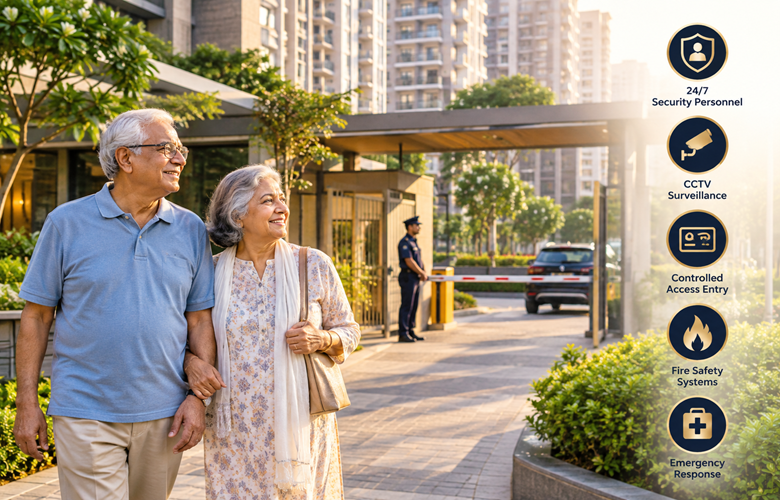
Senior Living Community Gurgaon and A senior living tower in Gurgaon needs a different safety test from the low-rise campuses most online checklists describe. To judge safety and security in a senior living community in India, check 3 layers against written rules: the building (refuge areas, ramps, anti-skid floors, backup power), the medical response (on-site ambulance, emergency room, hospital tie-up) and the people and paperwork (police-verified staff, CCTV, a tri-partite service agreement). The Ministry of Housing and Urban Affairs set these baselines for retirement homes in March 2019, and the National Building Code 2016 adds the fire rules for tall buildings.
Key Takeaways
- India had 149 million people aged 60 and above in 2022, and the number is projected to reach 347 million by 2050.
- India’s March 2019 model guidelines for retirement homes list an on-site ambulance at all hours, a medical emergency room and a mandatory tie-up with the nearest hospital and pharmacy.
- Buildings taller than 24 metres must provide refuge areas under the National Building Code 2016.
- A ramp at a 1:12 gradient should have a horizontal run of no more than 6 metres and a clear width of at least 1,200 mm.
- About 1 in 10 Indians aged 60 and above reported 2 or more falls within 2 years in the 2017 to 2018 national ageing survey.
- The Interest Free Maintenance Security (IFMS) deposit in a retirement home is refundable within a maximum of 3 months from the refund application.
Senior Living Safety Checklist for Indian High-Rise Towers
Most senior living safety checklists that rank online come from rental operators abroad, where residents lease a unit on a campus of 1 or 2 floors and the operator owns the building. A family in Gurgaon usually buys the apartment outright, often in a tall tower, and signs papers that decide who runs security and medical services for years. That changes the test.
Every safety claim in a brochure should map to a written rule, a drawing or a signed clause.
This guide follows that order: the national baseline for retirement homes, the fire code for tall buildings, fall prevention, medical response, security staff and, finally, the agreement that holds each promise in place.
Retirement Home Guidelines in India: The 2019 Baseline
In March 2019, the Ministry of Housing and Urban Affairs issued guidelines for developing and regulating retirement homes and asked States and Union Territories to align their rules with them. The guidelines link retirement homes to the National Building Code, the Model Building Bye-Laws, and the national barrier-free design standards for elderly persons.
For the built environment, the 2019 rules list these features:
- Lifts with audio and visual signage and signalling systems
- Wheelchair access, mandatory ramps and barrier-free movement between spaces
- Anti-skid tiles in bathrooms and on stairs
- Elderly-friendly door knobs, handrails and furniture
- Gas leak detection systems in kitchens
- Power backup in corridors, the lobby, lifts and apartments
Use this list as a first pass on any site visit. If a project cannot show where each item appears on its plans, that gap tells a family more than any render.
Fire Safety for Elderly Residents in High-Rise Buildings
Height changes the evacuation problem. The National Building Code 2016 requires refuge areas in buildings taller than 24 meters, which are fire-protected zones inside the building where occupants wait for firefighters when they cannot get down the stairs quickly. The same code does not treat ordinary passenger lifts as an escape route during a fire.
For a resident who walks with a stick or uses a wheelchair, the plan for the first few minutes of a fire matters more than the extinguisher in the corridor. In a senior tower, ask to see:
- The nearest refuge zone to the apartment you are considering, marked on the approved plan
- The firefighter lift and how staff will use it to move residents who cannot take the stairs
- Smoke detection inside each apartment, not only in shared corridors
- The fire safety approval issued for the building
- The drill record, including how residents with limited mobility were moved
Fall Prevention and Barrier-Free Design in Senior Housing
Falls are the everyday risk for older adults. In India’s 2017 to 2018 national ageing survey, about 1 in 10 people aged 60 and above reported 2 or more falls within the previous 2 years.
India’s 2021 accessibility standards give measurable numbers a family can check on site. A ramp at a 1:12 gradient should have a horizontal run of no more than 6 metres, the clear width of a ramp should be at least 1,200 mm, and ramp and landing surfaces should be slip resistant.
Inside the apartment, look for level entries without steps, grab bars beside the toilet and in the shower, anti-skid bathroom floors and light switches a resident can reach from bed. Walk the route from the bedroom to the bathroom with the lights off. If you hesitate, a resident will too.
Emergency Response in Senior Living: Medical Readiness
The 2019 guidelines list the medical and safety services a retirement home should offer: an on-site ambulance available day and night, a mandatory emergency tie-up with the nearest hospitals and a pharmacy, a medical emergency room, regular medical check-ups for residents and emergency alarm systems.
Each item can be tested with one plain request. Ask for the night staff roster, the spot where the ambulance is parked and the signed hospital tie-up rather than a logo on a brochure. Then run the 4 a.m. test: ask the team to demonstrate an alarm call and note who responds and how long it takes.
An alarm that nobody answers at night is decoration, not safety.
Senior Living Security Features: Staff, CCTV and Visitor Control
Security in a retirement community is mostly about people. The 2019 guidelines call for trained and skilled security personnel, CCTV cameras in common areas, and prior police verification of all personnel deployed in the community.
Push on the word all. Housekeepers, drivers, caregivers and kitchen contract staff enter homes daily, so their verification matters as much as the guard’s. Ask how the visitor log handles deliveries and domestic help, whether residents can pre-approve guests from a phone, and confirm that cameras cover shared spaces only.
For concerns that need help from outside the community, the Ministry of Social Justice and Empowerment runs Elderline 14567, a toll-free national helpline for senior citizens that is open from 8 AM to 8 PM every day.
Tri-Partite Agreement and IFMS: The Paperwork Layer
A safety promise lasts only as long as someone is contractually bound to deliver it. Under the 2019 guidelines, a developer can run a retirement home or appoint a service provider, and that provider must be registered with the appropriate state authority. The guidelines set out a tri-partite agreement between the developer, the service provider and the buyer, which discloses the provider’s technical skill at the time of the agreement to sell.
Money has its own safeguard. The IFMS deposit is refundable within a maximum of 3 months from the date of the refund application, while maintenance charges are paid separately as a lump sum or in installments on agreed terms. The guidelines also state that retirement home apartments should be sold only after registration with the state real estate regulator, which for Gurugram projects is the Haryana Real Estate Regulatory Authority (HARERA).
Questions to Ask When Touring a Senior Living Community
Carry these 7 questions on any site visit and ask for each answer in writing:
- Which refuge floor serves this apartment?
- Who answers an emergency alarm at 4 a.m., and how many trained staff are on duty at night?
- Where is the ambulance parked, and does it stay on site round the clock?
- Which hospital has signed the emergency tie-up, and may I see the document?
- Are all staff police verified, including contract workers who enter homes?
- Which service provider is named in the tri-partite agreement, and where is it registered?
- How and when is the IFMS deposit refunded?
Our Advisory Desk: What Families Miss on a Senior Living Site Visit
Families usually start a senior living search with the clubhouse, the floor plan, and the price. Our desk asks them to start at the other end of the building: the stairwell, the refuge floor and the night roster. A clubhouse is easy to judge on a tour. A night emergency is not, and it is the scenario that decides whether a parent is safe.
Our standing advice to adult children who live in another city or country is to collect 3 documents before booking: the approved building plan with refuge areas marked, the draft service or tri-partite agreement, and the schedule of medical services with the named hospital partner. When a project is in the early stages and a document isn’t ready yet, note when it will be shared and keep the final decision open until then.
For a community that is already operating, we suggest 2 visits: one during the day and one after dark, when staffing is thinnest. The second visit shows how the building actually runs for a resident.
“A safety feature that is not written into the agreement is a promise, not a feature.”
Safety Features Planned at DLF The Aureva Sector 63 Gurgaon
DLF Aureva is DLF’s first dedicated senior living project, located in Sector 63 on Golf Course Extension Road, Gurugram. DLF has planned the development at about 5 lakh sq ft, with a revenue potential of around ₹2,000 crores.
The plan for The Aureva by DLF Gurgaon includes an in-house 22-bed medical facility and round-the-clock emergency healthcare support. The project also features wheelchair-friendly washrooms and circulation, grab bars, handrails, emergency alarm systems, and HEPA filtration for indoor air quality.
The project is at the Expression of Interest (EOI) stage. As detailed drawings and agreements are released, families can apply the checklist above to the refuge plan, the service agreement, and the medical services schedule.
Key Takeaways for Families Choosing Senior Living in Gurgaon
A safe senior living home is one where every safety claim traces back to a rule, a drawing or a signed clause.
- Match the brochure against the 2019 national rules for retirement homes: ramps, anti-skid floors, gas leak detection, backup power, and lifts with audio and visual signals.
- In any building taller than 24 metres, find the protected holding zone nearest the apartment and ask how staff move residents who cannot use stairs.
- Test medical readiness at night through the on-site ambulance, the emergency room, and the signed hospital tie-up.
- Read the tri-partite agreement and the IFMS refund terms before paying beyond an expression of interest.
- Confirm that police verification covers every staff member who enters a home.
Read more: https://www.dlftheaurevagurgaon.com/blog/
FAQs on Safety and Security in Senior Living
What should I check first to judge safety in a senior living community?
Start with the fire plan, because fire is the one risk an older resident cannot outwalk. Ask where the nearest refuge floor is, how residents who use walkers are evacuated and when the last drill ran. Then check the medical response, staff verification and the service agreement. A well-run community should answer all 4 in writing.
What safety features should a retirement home in India have?
India’s 2019 model guidelines for retirement homes list lifts with audio and visual signals, ramps, wheelchair access, anti-skid tiles in bathrooms and on stairs, handrails, kitchen gas leak detection and backup power in corridors, lobbies, lifts and apartments. They also list an on-site ambulance, a medical emergency room and CCTV in common areas.
Are high-rise buildings safe for elderly residents?
A high-rise can suit elderly residents when its fire design plans for slower movement. The National Building Code 2016 requires refuge areas in buildings taller than 24 metres, where residents wait for rescue. You should confirm the refuge floor locations, a firefighter lift, smoke detection in each home and staff trained to move residents who cannot use stairs.
Who answers an emergency alarm in a senior living community?
The answer should name a trained person on site at every hour, not a distant call centre. Ask for the night roster, the number of staff on each shift and where the on-site ambulance is parked. India’s 2019 guidelines list emergency alarm systems and a 24×7 on-site ambulance, so request both commitments in writing before you sign.
Should staff in a senior living community be police verified?
Yes. India’s 2019 model guidelines for retirement homes call for prior police verification of all personnel deployed in the community, along with trained security staff and CCTV cameras in common areas. You should ask whether this covers contract workers such as housekeepers, drivers and caregivers, and how often the verification records are refreshed.
What is a tri-partite agreement in senior living?
A tri-partite agreement is a contract signed by the developer, the service provider and the buyer. India’s 2019 model guidelines use it to disclose the service provider’s technical skill at the time of the agreement to sell. It tells you who is legally responsible for security, medical and maintenance services once residents move in.
How is the IFMS deposit refunded in a retirement home?
Under India’s 2019 model guidelines, the Interest-Free Maintenance Security deposit is refundable within a maximum of 3 months from the date you apply for the refund. Maintenance charges are separate and can be paid as a lump sum or in monthly, quarterly, or yearly installments, as agreed. Your agreement should state both terms clearly.
How do I check if a senior living project in Gurugram is registered?
Search the project on the Haryana Real Estate Regulatory Authority website and match the registration number, promoter name and possession date with the documents you receive. India’s 2019 model guidelines state that retirement home apartments should be sold only after registration with the state regulator, so registration is the first document to confirm.
What safety features are planned at DLF The Aureva Sector 63?
DLF The Aureva Sector 63 is DLF’s first dedicated senior living project on Golf Course Extension Road, Gurugram. Its plan includes an in-house 22-bed medical facility, round-the-clock emergency healthcare support, grab bars, handrails, emergency alarm systems and wheelchair-friendly washrooms. Families can compare these features with this checklist and find DLF Aureva Gurgaon project

Arman Khan
Arman Khan is a Real Estate Market Analyst and SEO Content Strategist specializing in luxury residential projects across Gurgaon, Delhi NCR, Dubai, and other high-growth property markets. He creates data-driven property guides, launch analyses, price trend reports, and investment insights backed by market research and verified developer information. His content helps homebuyers and investors make informed decisions by simplifying complex real estate data into practical, user-focused insights.