
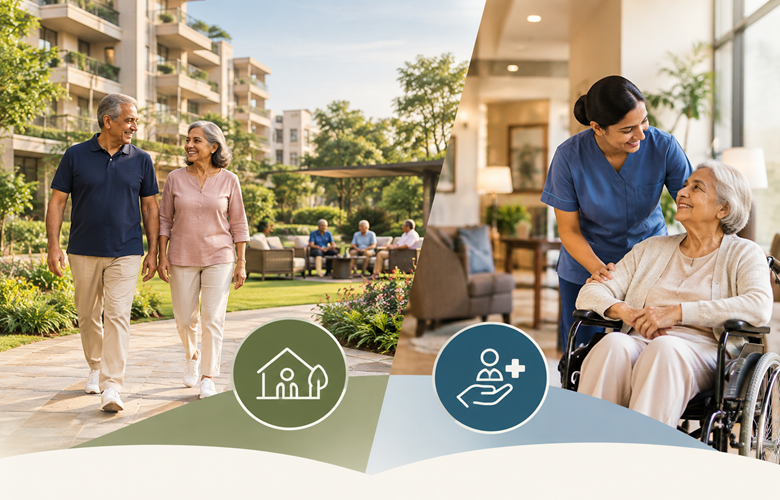
Senior Living vs Retirement Homes in Gurgaon – The Real Difference
The words “Senior Living and Retirement Homes in Gurgaon” are often used as if they describe the same thing. They do not always mean the same residential experience.
A retirement home broadly refers to housing chosen after retirement for security, convenience and easier day-to-day living. Senior living is a wider concept. It can include independent living, assisted living, wellness-led communities and residences planned around the changing needs of older adults.
This distinction matters in Gurgaon, where families are increasingly looking beyond the conventional choice of keeping ageing parents in a standard apartment. Many seniors remain financially independent, socially active and physically capable, but want a home with lower maintenance, stronger community connections, accessible design, wellness facilities and healthcare support nearby.
That is where purpose-built Senior Living Apartments Gurgaon can differ from a traditional retirement home.
DLF Aureva represent this newer direction. Located in Sector 63, Gurgaon, the project is positioned as a luxury senior-living development rather than a conventional old-age home. Its published configuration is 4 BHK + Staff, approximately 4,180–4,200 sq. ft., within a single tower with 172 residences. The development also includes a planned 8,500 sq. ft. medical and wellness facility, a 29,000 sq. ft. clubhouse and a 1.5 km wellness walking trail.
The central idea is simple: retirement is a life stage, while senior living is a residential model. A retirement home may provide somewhere to stay; a well-designed senior-living community is intended to influence how residents live, move, socialise and age there.
What Is Senior Living?
Senior living refers to residential communities designed around the lifestyle, accessibility, safety, wellness and social needs of older adults. It can range from independent living for active seniors to assisted living for residents who need additional help with daily activities.
Independent senior living is particularly relevant to people who can manage their own routines but want a more convenient, age-friendly residential environment. Community activities, recreation, fitness, housekeeping, security, accessible circulation and healthcare support may be integrated into the development.
Senior living therefore does not automatically mean medical care or dependency. Many residents choose it precisely because they want to remain independent for longer while reducing the practical responsibilities associated with maintaining a conventional home.
What Is a Retirement Home?
Retirement home in India is a broad term. The model can range from a simple apartment community to a managed retirement complex offering meals, recreation, security, housekeeping and healthcare-related services.
The label alone does not tell a buyer how much support is available. One retirement community may be designed almost entirely for independent residents, while another may have assisted-care services.
Buyers should ask what happens if needs change. Is emergency support available? Is healthcare on-site or nearby? Are bathrooms, corridors and lifts accessible? Are meals optional? Can residents arrange additional assistance? What are recurring service charges?
Those questions reveal the actual model behind the name.
Senior Living vs Retirement Homes: A Practical Comparison
Senior living generally puts greater emphasis on an age-friendly lifestyle ecosystem: independence, wellness, community, accessibility and support. A retirement home is a broader housing description and may provide anything from basic retirement accommodation to a managed community.
Senior living may include purpose-designed apartments, recreational facilities, walking routes, fitness, social activities and coordinated healthcare. Retirement homes may also provide these features, but the level varies significantly from property to property.
The right comparison is therefore not the label. It is the actual services, design, ownership model, care level and resident experience offered by a particular development.
Why Gurgaon Is Seeing More Interest in Senior Living
Gurgaon combines affluent households, strong healthcare infrastructure, a large professional population and families whose adult children may work in different cities or countries.
India’s organised senior-living market is also expanding. Recent industry research indicates that organised supply remains small compared with potential demand, while demographic ageing, longer life expectancy, changing family structures and rising income levels are increasing interest in professionally managed senior housing.
This does not mean every senior needs a specialised community. Some older adults prefer their existing family home; others want a managed residence; others may prefer a luxury independent-living community where privacy and services coexist.
The appropriate model depends on health, finances, family structure, lifestyle preferences and the amount of support a resident wants today and may need later.
Independence Is the Biggest Difference
One of the most important differences between modern senior living and the stereotype of a retirement home is the role of independence.
Independent senior living is built around residents continuing to make their own choices. They can decide when to wake up, exercise, socialise, dine, travel, host family or enjoy private time. Services are intended to reduce friction, not necessarily control the resident’s routine.
This connects directly with active ageing. Retirement does not have to mean withdrawing from social or physical activity. A well-designed community can make walking, meeting people, pursuing hobbies and maintaining a predictable routine easier.
For families, the conversation can therefore change from “where can parents be looked after?” to “where can parents live independently while appropriate support remains available?”
Healthcare: Support Without Turning Home Into a Hospital
Healthcare is important, but senior living should not automatically be confused with a hospital or nursing facility. A senior-living community can provide wellness, medical coordination, emergency response or easier access to healthcare while residents continue living in their own homes.
DLF Aureva Sector 63 Gurgaon is positioned around this model. Its published information includes an approximately 8,500 sq. ft. medical and wellness facility within the development, alongside senior-friendly circulation, wheelchair-friendly washrooms, grab bars, handrails and emergency alarm systems.
Before booking, buyers should translate “healthcare support” into actual services. Ask whether consultations, nursing, physiotherapy, emergency response, medicines or hospital transfers are included or separately chargeable.
The Home Itself Matters
Senior living is not only about common amenities. The apartment must remain comfortable as residents age.
Accessible circulation, practical bathrooms, suitable lift access, good lighting, reduced trip hazards and functional kitchens can become increasingly important. At the same time, a luxury senior home should still feel like a genuine private residence rather than an institutional room.
DLF The Aureva follows this residential approach with large 4 BHK + Staff homes of approximately 4,180–4,200 sq. ft. The published concept includes senior-sensitive planning, deep balconies and dual-master-bedroom planning.
For buyers comparing Luxury Senior Living Apartments with conventional retirement facilities, the emotional experience of owning a substantial private home remains an important part of the proposition.
Amenities: Lifestyle Instead of Just Occupancy
Traditional retirement housing may focus heavily on security and convenience. Modern senior living increasingly adds lifestyle infrastructure.
The published DLF The Aureva amenity plan includes a 29,000 sq. ft. clubhouse and lobby, temperature-controlled swimming pool, spa, yoga and Pilates studios, library and recreational lounges, banquet and social spaces, badminton and pickleball courts, landscaped gardens and a 1.5 km wellness walking trail.
These facilities have a practical purpose. Walking infrastructure can encourage movement, lounges can create informal social interaction, fitness studios can support exercise and community spaces can make companionship easier.
Amenities therefore become part of the residential model rather than simply decorative additions.
Community and Social Connection
Moving into a senior-living community can change the social structure of everyday life. In a conventional apartment, residents may have neighbours but little organised interaction. In a purpose-built senior community, shared activities and common spaces can make social engagement easier.
This can matter when adult children live elsewhere. Parents can maintain their own home and routines while gaining a community around them.
The purpose is not to replace family relationships. It is to add a social layer so residents do not depend entirely on family availability for companionship, recreation or everyday interaction.
Senior Living Is Not the Same as Assisted Living
Independent senior living generally suits residents who can manage everyday activities themselves and want convenience, safety, community and lifestyle support. Assisted living is designed for people who need help with activities such as bathing, dressing, medication management or mobility.
A project may offer independent living with optional additional services, while another facility may primarily provide assisted care.
Before booking, clarify eligibility, service levels and the care escalation process. If a resident’s needs increase in five or ten years, the available options may matter more than the clubhouse size today.
Why DLF Aureva Represents a New Senior-Living Model
DLF Aureva Gurgaon illustrates the shift from the conventional idea of a retirement home toward luxury independent senior living.
Its Sector 63 location on the Golf Course Extension Road corridor combines a premium residential address with purpose-built senior infrastructure. The project is planned as one dedicated tower with 172 residences and only four homes per floor. The published development size is approximately 4.17 acres.
The proposition is not simply housing for retired people. It combines a private luxury residence with wellness, healthcare support, recreation, accessibility and community.
This can be relevant to families who want parents to remain independent but do not want them to manage every aspect of a large conventional home alone.
Who Should Consider Senior Living in Gurgaon?
Senior living may appeal to active retirees who want a lower-maintenance and more social lifestyle. It can suit parents whose children live in another city or overseas. It may also work for couples who want to plan proactively for ageing rather than waiting for a health event.
However, senior living is not automatically right for everyone. Some residents strongly prefer their existing neighbourhood or a multigenerational household. Others may require a level of clinical care that an independent-living community does not provide.
The decision should be based on the resident’s preferences and future needs, not on a generic idea of what retirement should look like.
How to Choose Between Senior Living and a Retirement Home
Start by defining the required level of independence. If the resident manages daily activities independently, compare independent senior-living communities with conventional retirement housing. If substantial assistance is already required, investigate assisted living or specialised care separately.
Next, compare the home itself: usable area, accessibility, bathroom design, balcony safety, storage, kitchen practicality and privacy.
Then examine healthcare. Ask what is physically on-site, what is coordinated externally and what costs extra.
Finally, evaluate lifestyle. How easy is it to walk? Are activities available? Are there social spaces? Can family stay overnight? Is the location convenient for children and grandchildren? What happens if needs change?
These questions provide a more useful framework than simply searching for the “best retirement home in Gurgaon.”
The Gurgaon Location Advantage for Senior Residents
For senior residents, location is about more than commuting. It is about hospitals, family, retail, recreation and essential services.
DLF The Aureva Gurgaon is located in Sector 63, with published location advantages including access toward Golf Course Extension Road, Golf Course Road, SPR, Sohna Road and NH-48. The project information also lists nearby schools, retail destinations and multiple hospitals.
Families should verify actual travel times themselves, especially during peak traffic, and distinguish operational connectivity from proposed infrastructure. A convenient location should be measured by the resident’s actual weekly routine.
What Families Should Check Before Booking
Families should clarify the care model, healthcare services, emergency response and accessibility. Review the apartment layout and specifications, recurring maintenance and hospitality charges, ownership and resale provisions, hospital access and family connectivity.
Ask what happens if care needs increase later. Visit the property at different times of day. Review the RERA status, sanctioned plans, agreement terms and possession schedule.
Most importantly, involve the senior resident in the decision. A successful senior-living move is not only a family convenience decision; it is the resident’s home and lifestyle choice.
Final Takeaway
Senior living and retirement homes overlap, but they are not interchangeable terms. Retirement home is a broad description of post-retirement housing, while senior living describes a wider residential ecosystem built around ageing, independence, wellness, accessibility and community.
The distinction is becoming more relevant in Gurgaon as families look for housing that allows parents to live independently while keeping healthcare, recreation, security and social connection closer to home.
DLF The Aureva represent this newer interpretation through a luxury senior-living format in Sector 63. Its large 4 BHK + Staff residences, dedicated medical and wellness facility, clubhouse, walking trail and senior-sensitive planning position it differently from a conventional retirement apartment.
Ultimately, the right choice is personal. The useful comparison is not simply senior living versus retirement homes. It is independent living versus assisted support, private space versus managed convenience, and today’s lifestyle versus the needs that may develop over the next decade.
Read more: Healthcare, Green Spaces & Connectivity
Frequently Asked Questions
What is the difference between senior living and retirement homes?
Retirement home is a broad term for housing designed for people after retirement. Senior living is a wider concept that can include independent living, assisted living, wellness, community, accessibility and healthcare support.
Is senior living only for people who need medical care?
No. Independent senior living is often designed for active seniors who can manage daily activities but want convenience, safety, social connection and age-friendly facilities.
What is independent senior living?
It provides a private residence and community environment for seniors who generally manage their own daily activities while benefiting from services, recreation, security, wellness and easier access to support.
What is assisted living?
Assisted living is intended for residents who need help with everyday activities such as bathing, dressing, medication management or mobility. The exact care model varies by community.
Is DLF Aureva Gurgaon a retirement home?
DLF Aureva Gurgaon is positioned as a luxury senior-living development in Sector 63, rather than a conventional old-age home. It combines private residences with wellness, healthcare and community infrastructure.
What are the DLF Aureva residence sizes?
The published project information lists 4 BHK + Staff residences of approximately 4,180–4,200 sq. ft.
What healthcare infrastructure is planned at DLF The Aureva?
The project publishes an approximately 8,500 sq. ft. medical and wellness facility within the development, alongside senior-friendly accessibility and emergency-oriented features.
What amenities are available at DLF The Aureva?
Published amenities include a 29,000 sq. ft. clubhouse and lobby, temperature-controlled pool, spa, yoga and Pilates studios, library, recreational lounges, social spaces, sports courts, landscaped zones and a 1.5 km wellness trail.
Can senior living support independent ageing?
Yes. Independent senior living is intended to support residents who can manage their routines while making daily life more convenient, social, accessible and wellness-oriented.
What should families check before choosing senior living in Gurgaon?
Check the care model, healthcare support, accessibility, apartment design, services and recurring charges, location, family connectivity, emergency response, ownership terms, RERA status and what happens if care needs change later.

Arman Khan
Arman Khan is a Real Estate Market Analyst and SEO Content Strategist specializing in luxury residential projects across Gurgaon, Delhi NCR, Dubai, and other high-growth property markets. He creates data-driven property guides, launch analyses, price trend reports, and investment insights backed by market research and verified developer information. His content helps homebuyers and investors make informed decisions by simplifying complex real estate data into practical, user-focused insights.