
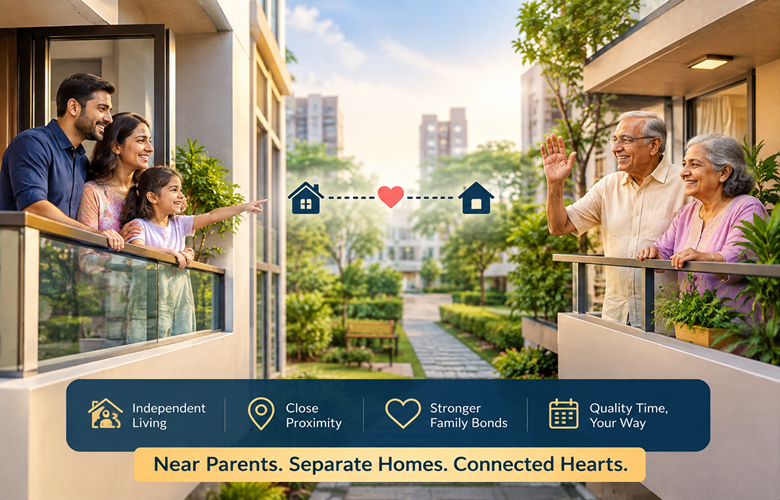
For many Indian families, the idea of children living separately from their parents still feels emotionally complicated. A separate home can be interpreted as distance. A shared home, meanwhile, can mean less privacy, different routines and more negotiation between generations.
But there is a third possibility: children and parents can live close to each other without living under the same roof.
That model is becoming more relevant as urban families change. Adult children may work long hours, travel frequently or live in different cities. Parents may be financially independent, socially active and capable of managing their own homes. The question behind Can Children Live Near Their Parents is no longer simply who will take care of Mum and Dad. It is how a family can stay close while allowing everyone to live well.
DLF The Aureva in Sector 63, Gurgaon represents the kind of housing concept that can sit between a traditional joint-family home and complete physical separation: a private residence designed for seniors, within a connected urban environment where family visits and support remain practical.
The Family Question Is Changing
The traditional Indian household was built around proximity. Parents, children and grandchildren often shared one property, and care was woven into daily routines. That model still works for many families, but it is no longer the only model.
Research on ageing and living arrangements in India has documented the growth of nuclear family structures and increasing numbers of older adults living independently. At the same time, family remains a major source of emotional and practical support. The opportunity is therefore not to choose between together and alone, but to create a better version of proximity.
Living nearby can mean dinner together without sharing the same kitchen. It can mean a grandchild visiting after school without changing the parents’ daily routine. It can mean an adult daughter dropping in after work rather than moving into the same domestic ecosystem. For affluent urban families, this is increasingly a lifestyle decision as much as a care decision.
Why Separate Homes Can Strengthen Family Relationships
Privacy is one of the underestimated ingredients of a healthy multigenerational relationship.
Parents may have their own routines: morning walks, social groups, hobbies, travel plans or quiet evenings. Adult children have their own schedules, careers, partners and children. Can Children Live Near Their Parents becomes an important question when these lifestyles are forced into one home, where affection can become mixed with everyday negotiation.
Two nearby homes create breathing room. Parents can make decisions about their own day. Children can maintain their routines. Both generations can still meet frequently because distance is small. The relationship becomes based more on choice than obligation.
Family closeness does not have to be measured by the number of nights everyone sleeps under one roof.
What Does Living Near Parents Actually Mean?
It does not necessarily mean buying two apartments in the same tower. The useful definition is functional proximity: a location from which family members can visit easily, respond quickly when necessary and share everyday experiences without requiring either generation to give up its home.
For a Gurgaon family, this might mean parents living in a senior-focused residence in Sector 63 while children live or work elsewhere along Golf Course Extension Road, Golf Course Road, Sohna Road or other connected parts of the city.
The shorter the practical journey, the more natural the relationship becomes. A short visit feels very different from a weekend trip. Coffee, a pharmacy run or family dinner becomes possible without planning an entire day around it.
Why DLF The Aureva Fits the Close-but-Separate Model
DLF The Aureva is relevant because its concept is not simply about putting older people into smaller retirement units. The project is positioned as a dedicated senior-living community with large-format residences and age-responsive planning.
Published project information describes a single tower on approximately 4.17 acres, with four homes per floor and 4 BHK plus staff residences of roughly 4,180 to 4,200 sq.ft. That scale allows senior residents to retain the spatial experience of a luxury home rather than treating senior living as automatic downsizing.
For families, a large home can accommodate children, grandchildren, guests and domestic support while preserving private rooms and routines. The larger proposition is simple: parents can have a home designed around their stage of life while children continue to have a home and life of their own.
The Home Matters More When Parents Live Independently
If parents are living independently, the design of their home becomes more important than it might be in a conventional family arrangement.
Accessibility should not be something added only after mobility becomes difficult. Wider movement paths, senior-sensitive bathrooms, handrails, grab bars and emergency systems can reduce everyday friction. Features such as these are described in the planning for DLF The Aureva.
This is one reason senior-focused housing can make sense even for healthy retirees. The purpose is not to predict a medical problem; it is to create a home that remains comfortable if circumstances change.
Healthcare Proximity Changes the Family Equation
For adult children, one of the biggest concerns about parents living separately is what happens in an emergency.
DLF The Aureva’s published plans include an approximately 8,500 sq.ft. medical and wellness facility within the development. The wider Sector 63 and Golf Course Extension Road corridor also provides access to major healthcare destinations in Gurgaon.
A senior-living community does not replace family care or a hospital. It means the housing environment can be designed with the realities of ageing in mind. For children, that can be reassuring: they do not have to be physically present every hour to remain meaningfully involved.
The Community Layer
A beautiful 4 BHK home cannot by itself solve social isolation. A parent may have excellent housing but still spend much of the week alone if children are working and grandchildren are at school.
DLF The Aureva is planned with a large clubhouse, wellness spaces, social areas and outdoor activity zones. Published plans include a 1.5 km wellness walking trail and facilities intended to encourage movement and recreation.
The important point is not the amenity count. It is the existence of reasons to meet other people. A morning walk, library visit, yoga class or casual conversation can become part of a resident’s weekly rhythm.
Grandchildren May Benefit Too
The conversation about senior living often focuses only on parents and adult children. Grandchildren matter too.
When grandparents and parents share a home, children get proximity but may also experience a busy household with competing routines. When grandparents live completely separately, spontaneous interaction can decline. Can Children Live Near Their Parents Without Sharing a Home becomes the middle-ground question: staying close enough for regular family time without requiring everyone to share the same home.
A nearby-home model creates a middle ground. Grandparents retain independence while grandchildren can visit frequently, stay over when appropriate and develop relationships that are not limited to holidays.
What About Parents Who Do Not Need Senior Living Yet?
Not every older adult needs a specialised community, and not every family should choose one.
A better way to think about senior living is as a long-term housing option. A healthy couple may value community, wellness, security and age-sensitive design today while appreciating additional support infrastructure later.
The decision should be based on lifestyle and future planning rather than fear. If parents enjoy independence, want a premium home, value social interaction and prefer to remain in Gurgaon, a purpose-built senior residence may be worth evaluating.
What Children Should Check Before Choosing a Senior-Living Home for Parents
· Distance in real travel time: test weekday traffic, not just the map.
· Home usability: check circulation, bathrooms, lifts, emergency systems and future mobility needs.
· Healthcare model: understand what is available on site, what is outsourced and how emergencies are handled.
· Community quality: ask how activities and resident engagement will work after possession.
· Privacy: ensure parents retain genuine control over their home and daily routine.
· Family visits: evaluate guest policies, parking, visitor access and child-friendly spaces.
· Operating costs: understand maintenance, clubhouse, healthcare and other recurring charges.
· Legal and project status: verify approvals, RERA registration where applicable, sanctioned plans and timelines.
· Future flexibility: consider resale, succession and what happens if care requirements change.
The Bigger Idea: Proximity Is a New Form of Family Care
Physical separation does not have to mean emotional separation. A child can live nearby and be deeply involved; another can live in another country and remain closely connected through visits, communication and organised support.
The quality of a family relationship is not determined by a shared address.
That is why projects such as DLF Aureva Gurgaon fit into a broader change in later-life housing. The goal is not to move parents away from their children. It is to give both generations a sustainable way to remain close.
Conclusion: Same Family, Different Homes
Children absolutely can live near their parents without sharing the same home-and for some families, that may become the healthiest long-term arrangement.
The model combines independence with proximity, privacy with connection and personal routine with family support. Senior living adds another layer by making the parents’ home more responsive to ageing, wellness, safety and community life.
DLF The Aureva in Sector 63 Gurgaon is a useful example because it combines large-format residences with senior-oriented planning and a connected Gurgaon location. Families should still assess parents’ preferences, health needs, lifestyle, finances and desired support before committing.
The future of family housing may not be one giant home for everyone. It may be several homes, close enough to function like one family.
FAQs
Can children live near their parents without sharing the same home?
Yes. Nearby living allows parents to retain a private residence while children remain close enough for frequent visits, shared meals, errands and emergency support.
Is living separately from parents neglect in India?
Not necessarily. Family support depends on involvement, communication, accessibility and care arrangements—not simply on sharing one address.
Why is independent senior living becoming more relevant in Gurgaon?
Urbanisation, nuclear families, longer working lives, migration and changing retirement expectations are increasing interest in housing that combines independence with support and community.
How does DLF The Aureva support independent living?
It is positioned around senior-focused residential planning, large-format homes, wellness infrastructure, age-responsive features and healthcare-oriented facilities while preserving private residences.
What is the configuration of DLF Aureva Gurgaon?
Published project information describes 4 BHK plus staff residences of approximately 4,180–4,200 sq.ft. Buyers should verify the latest sanctioned specifications and availability.
Where is DLF The Aureva Sector 63 located?
It is positioned in Sector 63, Gurgaon, along the Golf Course Extension Road corridor.
Can grandchildren visit senior-living communities?
Visitor policies vary, but family-oriented senior living is designed to preserve intergenerational interaction rather than isolate residents.
Does senior living mean parents need medical care
No. Independent senior living can be chosen by healthy older adults who value age-sensitive design, wellness, community and future-readiness.
What should children consider before buying for parents?
Consider location, accessibility, healthcare, community, privacy, service model, recurring costs, legal status, project timeline and what happens if care needs change.
Is DLF The Aureva suitable for every family?
No. Suitability depends on parents’ preferences, health, lifestyle, finances, family proximity and expectations about services.
Can separate homes improve parent-child relationships?
For some families, yes. Privacy can reduce everyday friction while proximity preserves spontaneous visits and support.

Arman Khan
Arman Khan is a Real Estate Market Analyst and SEO Content Strategist specializing in luxury residential projects across Gurgaon, Delhi NCR, Dubai, and other high-growth property markets. He creates data-driven property guides, launch analyses, price trend reports, and investment insights backed by market research and verified developer information. His content helps homebuyers and investors make informed decisions by simplifying complex real estate data into practical, user-focused insights.