
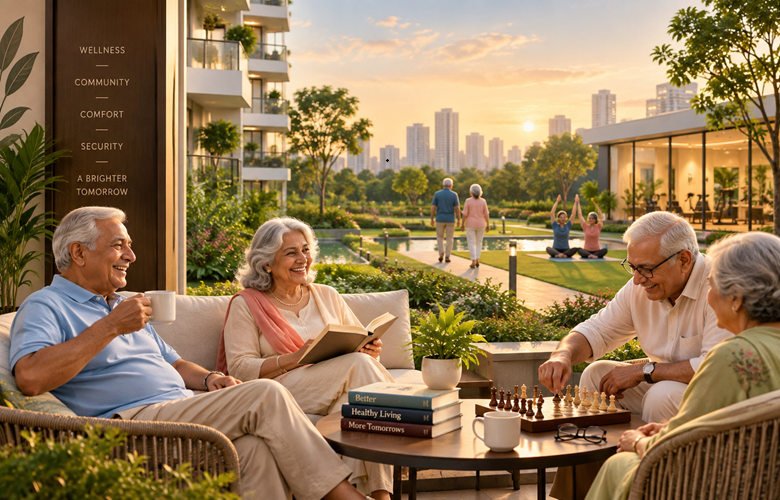
Senior living communities are redefining retirement in India by moving it from care-driven old age homes to independence-driven residential communities. India had just 22,157 organised senior living units in June 2025 against demand from 1.7 million households, according to ASLI and JLL, and DLF has now entered the category with DLF The Aureva Sector 63 Luxury Senior Living in Gurgaon.
Key Takeaways
India’s 60+ population is set to more than double, from 156.7 million in 2024 to 346 million by 2050 (ASLI-JLL).
• Organised senior living supply stood at only 22,157 units in June 2025 against demand from 1.7 million households (ASLI-JLL).
• The market can reach USD 8 billion, about ₹69,400 crores, by 2030 under a policy-supported scenario (ASLI-JLL, August 2025).
• Established senior living communities in India report 80 to 85% occupancy (ASLI-JLL).
• DLF has entered the segment with DLF The Aureva Sector 63, a single-tower community of 172 residences on Golf Course Extension Road with a Medanta healthcare collaboration, targeting about ₹2,000 crore in revenue (Business Today).
Why Retirement Housing in India Is Being Rebuilt from Scratch
India’s population aged 60 and above stood at 156.7 million in 2024 and is projected to reach 346 million by 2050, according to the ASLI-JLL report on senior living. That makes India home to the world’s 2nd largest senior population within 25 years.
The housing stock built for this generation has not kept pace. Only about 1.3% of potential senior living demand in India is currently met, compared with over 6% in mature markets such as the United States and Australia, per the same ASLI-JLL research.
Family structure explains the urgency. Urban households have become more nuclear, children increasingly work in other cities or abroad, and a large independent house becomes a maintenance burden rather than a comfort after 65. Retirement homes in Gurgaon and other metros were historically framed as a last resort. The new generation of communities inverts that framing entirely.
Retirement housing in India was designed around dependence. The new wave is designed around independence. That single shift changes the product, the address, and the buyer.
The Supply Gap Behind the Senior Living Boom
The numbers make the case better than any adjective. Organized senior living supply grew from 7,147 units in 2014 to 22,157 units by June 2025, according to ASLI and JLL. Demand in 2025 already stands at 1.7 million households and is projected to reach 2.3 million by 2030.
Even the optimistic supply scenarios fall far short. The ASLI-JLL report projects roughly 15,000 new senior homes by 2030 on the current trajectory, and up to 34,600 units with strong policy support. Established communities already run at 80 to 85% occupancy, which signals that supply, not appetite, is the constraint.
| Market Indicator | Figure | Source |
| Population aged 60+ in India, 2024 | 156.7 million | ASLI-JLL |
| Population aged 60+ projected by 2050 | 346 million | ASLI-JLL |
| Organized senior living supply, June 2025 | 22,157 units | ASLI-JLL |
| Organized supply back in 2014 | 7,147 units | ASLI-JLL |
| Demand, 2025 | 1.7 million households | ASLI-JLL |
| Projected demand by 2030 | 2.3 million households | ASLI-JLL |
| Occupancy in established communities | 80 to 85% | ASLI-JLL |
| Market size potential by 2030 | USD 8 billion (about ₹69,400 Cr) | ASLI-JLL |
| Demand opportunity by 2030 | ₹64,500 crore | Anarock |
Anarock places the demand opportunity at ₹64,500 crore by 2030, while the ASLI-JLL report models the market reaching USD 8 billion in the same period. This gap is exactly why India’s largest developers are entering the category now.
What Modern Senior Living Communities in India Actually Offer
The phrase senior living covers a spectrum, from independent living to assisted living and specialized care. The communities driving the current shift focus on independent living for active seniors, built on 5 pillars:
- Full private residences. Complete apartments that residents own or lease, not shared rooms or dormitory formats.
- Integrated healthcare. On-site medical facilities, emergency response systems, and tie-ups with major hospitals rather than a visiting doctor once a week.
- Hospitality services. Professional operators handle housekeeping, dining, concierge, and maintenance.
- Designed-in safety. Senior-friendly layouts, anti-skid surfaces, grab rails, and 24×7 security as part of the base design.
- Community programming. Clubs, fitness, cultural calendars, and shared spaces that keep social life active.
Geography tells its own story. Southern India holds about 60% of the country’s organized senior living supply, per JLL, because cities like Coimbatore, Chennai, and Bengaluru moved first. The next phase of growth is now shifting north, and senior living communities in India are increasingly being planned inside metro luxury corridors rather than on city fringes.
Why Gurgaon Has Become the Address for Luxury Senior Living
Gurgaon offers 3 things a senior living community cannot manufacture. First, hospital density: Medanta The Medicity, Fortis Memorial Research Institute, and Artemis all operate large multi-specialty facilities in the city. Second, 2 decades of professionally managed gated communities, which means service standards seniors can rely on. Third, a deep base of affluent families and NRIs who want parents close to them, not in a distant hill town.
Several operators, including Antara and Ashiana, have been active in the NCR retirement segment for years. The decisive signal came when DLF, India’s largest listed real estate developer, chose Gurgaon’s Golf Course Extension Road for its first senior living project. Luxury senior living in Gurgaon moved from a niche experiment to a mainstream category the moment that decision was made public.
DLF The Aureva Sector 63 | A Case Study in Retirement Redefined
DLF The Aureva is DLF’s first dedicated senior living development, located in Sector 63 on Golf Course Extension Road within the established DLF Arbour campus. Business Today reports that DLF expects about ₹2,000 crores in revenue from the project, a scale that signals long-term commitment to the category rather than a trial run.
The plan reads like a direct answer to everything older retirement formats got wrong. Spread across roughly 4.17 acres, the community is a single tower of just 172 residences, with only 4 homes per floor. Each residence is a 4 BHK of around 4,200 sq.ft., which makes downsizing unnecessary; a family moving from a large Delhi house gives up maintenance, not space.
Healthcare is the anchor. The project is planned in collaboration with Medanta, including an on-site, Medanta-managed health facility, so emergency response and routine care are on campus instead of across the city.
The address does the rest. Sector 63 connects directly to Golf Course Extension Road, with onward access to Golf Course Road, SPR, Sohna Road, NH-48, and the Rapid Metro network. Family visits from anywhere in NCR stay easy, daily conveniences stay close, and residents remain part of the city’s mainstream rather than isolated from it. That is the redefinition in 1 sentence: DLF The Aureva Gurgaon treats retirement as an upgrade to a better-serviced address, not a retreat from life.
What We Are Seeing on the Ground Along Golf Course Extension Road
Our team closely tracks inquiry patterns on this microsite, and the senior living buyer profile has visibly changed over the past year. The most common inquiry now comes from children in their 40s, many settled abroad, shortlisting a residence for parents who still maintain a large independent house in Delhi or Gurgaon. The parents are not being moved into care. They are being moved into convenience.
The 2nd pattern is self-planning. Couples in their late 50s are enquiring for themselves, often while still working, because they want to choose their retirement address early rather than react to a health event later. For them, the Medanta name attached to DLF Aureva Gurgaon matters more than any amenity list, and the 172-residence scale matters more than a large clubhouse. Small communities are easier to belong to.
“The most telling shift is the address. When retirement housing moves from the edge of the city to Golf Course Extension Road, it stops being a compromise and starts being a choice.”
How to Evaluate a Senior Living Community Before You Commit?
Whichever project you shortlist, run the same 5 checks:
- Verify RERA registration on haryanarera.gov.in and match the promoter name, project area, and timelines against what the sales team tells you.
- Read the age-eligibility and resale clauses. Who can live in the unit, who can inherit it, and on what terms can it be sold?
- Study the service agreement separately from the sale agreement: monthly charges, what they cover, how care escalates, and how fees revise over time.
- Assess the healthcare arrangement. A named hospital partner with an on-site facility is a different commitment from a doctor-on-call clause.
- Weigh the location against your family map. A community 20 minutes from your children beats a better-priced one 3 hours away.
The Bottom Line on India’s Retirement Shift
Luxury Senior Living in Gurgaon, India, retirement is being redesigned around independence, and the data says the shift has barely begun.
- Demand of 1.7 million households against 22,157 organized units means the category will be supply-led for years (ASLI-JLL).
- India’s 60+ population reaching 346 million by 2050 makes senior housing a structural theme, not a cycle.
- Gurgaon’s hospital density and gated-community standards have made it the natural northern hub for the category.
- DLF The Aureva Sector 63 shows what the redefined product looks like: 172 large residences, 1 low-density tower, a Medanta healthcare collaboration, and a mainstream luxury address.
If you are planning a residence for your parents or your own retirement on Golf Course Extension Road, you can request the floor plans and project details for DLF Aureva Sector 63 Gurgaon through the inquiry form on this site.
FAQs on Senior Living Communities in India and DLF The Aureva
What is redefining retirement living in India in 2026?
Purpose-built senior living communities are redefining retirement in India by replacing charity-run old age homes with professionally managed residential communities. Residents get independent apartments, on-site healthcare, hospitality services, and a structured social calendar in a single community. ASLI and JLL project demand to grow from 1.7 million households in 2025 to 2.3 million by 2030.
What is DLF The Aureva in Sector 63, Gurgaon?
DLF The Aureva is DLF Limited’s first dedicated senior living project, located in Sector 63 on Golf Course Extension Road, Gurgaon. It is planned as a single low-density tower of 172 residences in a 4 BHK format of around 4,200 sq.ft. each, within the established DLF Arbour campus, supported by a Medanta healthcare collaboration.
Who can buy or live in a senior living project in Gurgaon?
Ownership of senior living residences in India is generally open to any buyer, while occupancy is reserved for residents who meet a minimum age criterion, commonly 55 or 60 years depending on the project. Confirm the exact eligibility clause, resident rules, and transfer conditions in the application and buyer agreement before booking any unit.
How is a senior living community different from a retirement home?
A retirement home usually offers basic shelter with limited services and a care-first framing. A modern senior living community offers full private apartments that you own or lease, plus integrated healthcare, housekeeping, dining, security, and social programming. Residents stay independent, and support scales up only when needed, which is the core difference in philosophy.
Why is Gurgaon becoming the center of luxury senior living in India?
Gurgaon combines large multi-specialty hospitals such as Medanta, Fortis, and Artemis with gated-community management standards and a deep base of affluent and NRI families. That mix makes it a natural home for luxury senior living in Gurgaon, and DLF choosing Sector 63 for its first senior living project confirms the corridor’s position.
How big is the senior living market in India?
Organized senior living supply in India stood at 22,157 units in June 2025, up from 7,147 units in 2014, according to ASLI and JLL. Their report projects the market can reach around USD 8 billion by 2030 under a policy-led scenario, while Anarock estimates the 2030 demand opportunity at roughly ₹64,500 crores.
What healthcare support is planned at DLF The Aureva Sector 63?
DLF The Aureva Sector 63 is planned with a healthcare collaboration with Medanta, including an on-site Medanta-managed health facility for residents. The design intent is proactive wellness and quick emergency response on campus, so day-to-day medical needs and urgent situations are handled without relying on distant hospital access alone.
What should you check before booking a senior living residence?
Verify the project’s RERA registration on haryanarera.gov.in, read the buyer agreement for age eligibility and resale rules, and study the service agreement covering monthly charges, care escalation, and operator responsibilities. Also confirm who runs healthcare and hospitality services long-term, because the operator matters as much as the developer in senior living.
Is independent senior living with healthcare in Gurgaon a good option for NRI families?
Yes, senior living communities in Gurgaon suit NRI families because parents get on-campus healthcare, security, staffing, and community life without depending on day-to-day family support. Many inquiries for DLF The Aureva Gurgaon come from children settled abroad who want a professionally managed residence for parents on a well-connected corridor near major hospitals.

Arman Khan
Arman Khan is a Real Estate Market Analyst and SEO Content Strategist specializing in luxury residential projects across Gurgaon, Delhi NCR, Dubai, and other high-growth property markets. He creates data-driven property guides, launch analyses, price trend reports, and investment insights backed by market research and verified developer information. His content helps homebuyers and investors make informed decisions by simplifying complex real estate data into practical, user-focused insights.